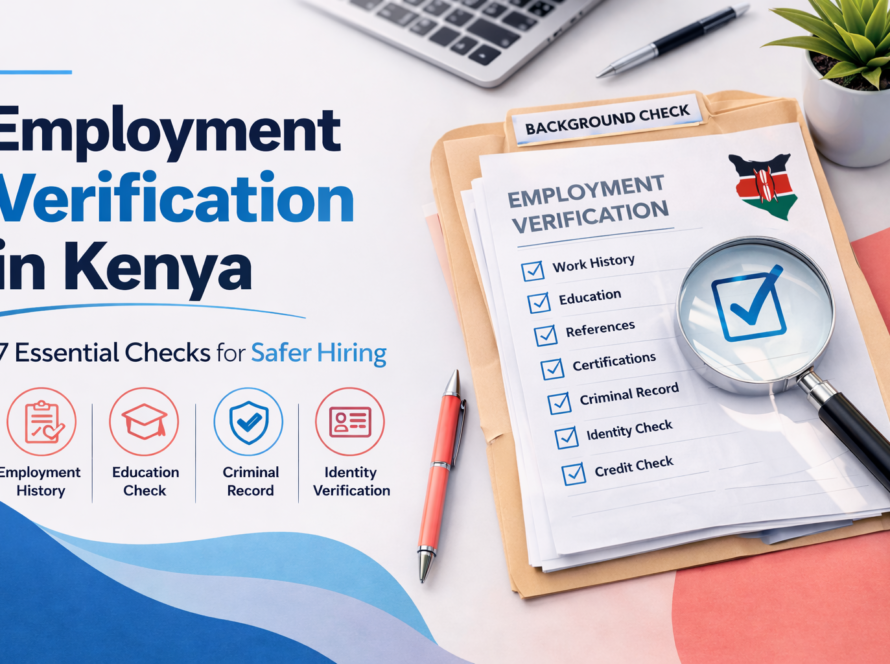
Data Protection in Kenya: 7 Essential Practices for Employers
Data protection is essential for every organization that collects, stores, processes, or shares personal information. In Kenya, employers and recruitment agencies must handle candidates’ and employees’ personal data responsibly, particularly when conducting background checks and employment verification.
The Kenya Data Protection Act, 2019 establishes requirements for protecting personal information and respecting individuals’ privacy rights.
For businesses conducting background screening, data protection is more than a legal obligation. It is an important part of building trust with candidates, clients, and employees.

What Is Data Protection?
Data protection refers to the legal, organizational, and technical measures used to ensure that personal information is collected, processed, stored, and shared responsibly.
In recruitment and employment verification, personal data may include:
- National identification information
- Employment history and professional references
- Academic and professional qualifications
- Contact details
- Verification documents and reports
- Other information relevant to a lawful screening process
Organizations should collect only the information necessary for a specified and legitimate purpose.
Understanding the Data Protection Act in Kenya
Kenya’s Data Protection Act, 2019 regulates the processing of personal information and establishes rights for individuals whose data is collected or used.
The Office of the Data Protection Commissioner (ODPC) oversees implementation of the country’s data protection framework.
Organizations acting as data controllers or processors must comply with applicable legal obligations, including lawful processing, transparency, purpose limitation, accuracy, security, and appropriate retention.
These requirements are especially relevant when organizations engage third-party providers to conduct employment screening.
7 Essential Data Protection Practices for Employers
1. Establish a Lawful Basis for Processing Personal Data
Before conducting employment background checks, employers should identify the lawful basis for collecting and processing candidate information.
Where consent is relied upon, it should be informed, specific, and appropriately documented. Consent is not the only possible lawful basis, and employers should assess which basis is appropriate for each processing activity.
2. Explain How Candidate Information Will Be Used
Transparency is a fundamental principle of data protection.
Candidates should receive clear information about the purposes of verification, the categories of data involved, relevant recipients, and their applicable rights.
Providing a privacy notice helps candidates understand how their personal information will be handled throughout the recruitment process.
3. Collect Only Necessary Information
Effective data protection requires organizations to avoid collecting excessive or irrelevant personal information.
For example, an employment history check may require confirmation of job titles, dates of employment, and professional responsibilities. It does not automatically justify obtaining unrelated private information.
The scope of screening should be proportionate to the responsibilities and risks of the position.
4. Secure Personal Data Against Unauthorized Access
Employers and verification providers should implement appropriate technical and organizational security measures.
These may include access controls, secure document storage, encrypted transmission, staff confidentiality requirements, and procedures for responding to security incidents.
Sensitive verification records should only be accessible to authorized personnel with a legitimate business need.
5. Maintain Accurate and Updated Records
Data protection also requires reasonable steps to maintain accurate personal information.
When a discrepancy arises during background verification, employers should distinguish between confirmed inaccuracies, incomplete records, and information that requires further clarification.
Candidates should have appropriate opportunities to address inaccurate or misleading information.
6. Establish Clear Data Retention and Disposal Procedures
Personal data should not be retained indefinitely without a lawful justification.
Employers should establish retention schedules that consider the purpose of collection, contractual obligations, applicable legal requirements, and potential disputes.
Once information is no longer needed and there is no lawful reason to retain it, organizations should securely delete or dispose of it.
7. Work With Responsible Verification Partners
Outsourcing background checks does not eliminate an employer’s responsibility to ensure personal information is handled lawfully.
Organizations should assess verification providers’ privacy practices, confidentiality safeguards, access controls, contractual obligations, and procedures for handling data subject requests.
A reliable verification partner should support accurate screening while respecting the privacy rights of candidates.
Data Protection and Employment Background Checks
Employment screening frequently involves processing personal information from multiple sources, including former employers, educational institutions, and professional bodies.
Organizations should ensure that verification activities are relevant to the role and supported by an appropriate lawful basis.
For more information about verifying candidates’ professional histories, read our guide on Employment Verification in Kenya.
Employers can also explore the role of Background Checks in Employment in reducing recruitment risks.
What Rights Do Candidates Have Under Kenya’s Data Protection Law?
Depending on the circumstances and applicable legal provisions, individuals have rights relating to the processing of their personal information, including the right to:
- Be informed about how their personal data is used
- Access personal information held about them
- Object to certain processing activities
- Request correction of inaccurate or misleading information
- Request deletion where applicable legal conditions are met
The ODPC provides additional guidance on the rights of data subjects.
Employers should establish procedures for receiving and responding to such requests.
Why Data Protection Matters to Semafacts
At Semafacts Services Limited, responsible handling of candidate information is an important consideration in the delivery of background verification services.
Our services support employers seeking reliable information about candidates’ qualifications, employment histories, professional references, and other relevant credentials.
A responsible screening process should balance employers’ need for accurate information with candidates’ rights to privacy, transparency, and fair treatment.
Organizations selecting a verification partner should assess the provider’s approach to lawful data processing, confidentiality, secure information handling, and appropriate reporting.
Frequently Asked Questions
What Is the Main Purpose of Data Protection?
The purpose of data protection is to safeguard personal information and ensure that organizations process it lawfully, fairly, securely, and transparently.
Does the Kenya Data Protection Act Apply to Recruitment?
Yes. Recruitment processes involving personal data are subject to applicable requirements under Kenya’s Data Protection Act, 2019.
Can Employers Share Candidate Information With Background Screening Companies?
Employers may share relevant information with screening providers where there is a lawful basis, appropriate transparency, and necessary contractual and security safeguards.
How Long Should Background Verification Records Be Kept?
Retention periods depend on the purpose of processing and applicable legal or contractual requirements. Organizations should document and apply appropriate retention schedules rather than keeping records indefinitely.
Conclusion: Building Trust Through Responsible Data Protection
Strong data protection practices help organizations reduce privacy risks, maintain accurate records, and build confidence in their recruitment processes.
For employers in Kenya, compliance should be integrated into every stage of background screening, from initial information collection to final reporting and secure record disposal.
Need professional background verification services in Kenya?
Contact Semafacts Services Limited to discuss your recruitment screening requirements.
Email: info@semafacts.com
Website: https://semafacts.com/
Reliable verification. Responsible information handling. Better hiring decisions.