Background check results play an important role in helping employers make informed recruitment decisions. While conducting background checks helps organizations verify candidate information, understanding and interpreting the findings is equally important.
A background screening report may confirm that the information provided by a candidate is accurate, identify inconsistencies requiring clarification, or reveal significant concerns that deserve further assessment.
However, not every discrepancy indicates dishonesty, and not every negative finding should automatically disqualify a candidate.
At Semafacts Services Limited, we classify background screening outcomes as Clear, Consider or Adverse to help employers understand verification findings and assess their significance.
Understanding these classifications enables organizations to make fair, consistent and evidence-based hiring decisions.
What Do Background Check Results Mean?
Background check results are the findings obtained after independently verifying information provided by a candidate or examining records relevant to an employer’s screening requirements.
Depending on the position and the agreed screening scope, these checks may include employment history verification, academic qualification verification, professional membership and licence verification, reference checks, identity verification, criminal record checks, credit checks and global sanctions screening.
The findings help employers establish whether the information presented during recruitment is consistent with records obtained from relevant sources.
A background screening report should distinguish between information that has been verified, information that could not be confirmed and discrepancies that require further investigation.
The purpose is not simply to identify negative information. It is to provide reliable evidence that supports responsible recruitment decisions.

What Semafacts’ Historical Screening Data Reveals
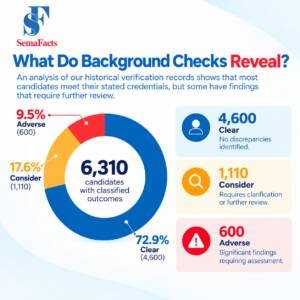
An analysis of 6,310 classified screening outcomes from Semafacts’ historical verification records provides insight into the findings that can emerge during background screening.
| Screening outcome | Number of outcomes | Percentage |
|---|---|---|
| Clear | 4,600 | 72.9% |
| Consider | 1,110 | 17.6% |
| Adverse | 600 | 9.5% |
| Total | 6,310 | 100% |
Most classified outcomes, representing 72.9%, were Clear.
However, 1,710 outcomes (27.1%) were classified as Consider or Adverse, indicating that the findings required further review or raised significant concerns.
These results demonstrate why employers benefit from independently verifying information rather than relying exclusively on candidate declarations.
Importantly, these figures represent Semafacts’ historical classified screening outcomes. They are not a nationally representative estimate of background screening results among job applicants in Kenya.
A Consider or Adverse classification should also not be interpreted as proof that a candidate committed fraud.
Understanding Clear Background Check Results
A Clear outcome indicates that no discrepancies were identified in the information covered by the completed verification.
For example, a candidate may indicate that they worked for a particular employer between January 2021 and December 2024.
If the previous employer confirms the relevant employment details and no inconsistencies are identified, the employment verification may be classified as Clear.
Similarly, an academic verification may receive a Clear outcome when the issuing institution confirms the qualification presented by the candidate.
What a Clear Outcome Means for Employers
A Clear result provides confidence that the specific information verified is consistent with the relevant records.
However, it is important to understand that a Clear background check does not guarantee future employee performance, workplace conduct or overall suitability for a position.
It also does not establish facts about matters outside the scope of the screening.
Employers should therefore consider background check results alongside interviews, competency assessments and other relevant recruitment information.
Understanding Consider Background Check Results
A Consider outcome indicates that a finding requires clarification, additional verification or further assessment before an employer makes a decision.
Such findings may involve inconsistencies that are not necessarily evidence of deliberate misrepresentation.
Examples of Consider Findings
Employment date discrepancies
A candidate may indicate that their employment ended in December, while the previous employer confirms November.
The difference may arise from inaccurate recollection, administrative records or other circumstances that require clarification.
Differences in job titles
A candidate may use a title that differs from the designation recorded by a former employer. This may reflect internal organizational terminology, a change in responsibilities or an inaccurate declaration.
Academic qualification inconsistencies
A qualification may contain differences in recorded names, dates or other details that require confirmation from the issuing institution.
Employment-related disciplinary findings
A previous employer may confirm a disciplinary matter that requires context to establish its nature, relevance and significance.
Does Consider Mean a Candidate Has Failed a Background Check?
Not necessarily.
A Consider classification does not automatically mean that a candidate provided false information or is unsuitable for employment.
It indicates that an employer should examine the finding before making a decision.
The appropriate response may involve requesting clarification from the candidate, obtaining additional documentation or undertaking further verification.
The seriousness of a finding depends on its nature, supporting evidence and relevance to the position.
Understanding Adverse Background Check Results
An Adverse outcome indicates that screening has identified a significant concern requiring careful assessment.
Compared with a Consider outcome, an Adverse finding generally involves a more material inconsistency or concern within the agreed screening scope.
Examples of Adverse Findings
Fraudulent academic qualifications
An issuing institution may confirm that a certificate presented by a candidate was not genuinely issued by that institution.
Material employment history misrepresentation
A candidate may declare employment with an organization that confirms having no record of the claimed employment, following appropriate verification and clarification.
Significant professional credential concerns
A professional body may confirm that a claimed registration or licence is invalid or was never issued.
Serious employment-related findings
Verified information about previous employment may reveal a significant concern relevant to the responsibilities of the position.
These findings may be particularly important when recruiting for positions involving financial accountability, public safety, confidential information or regulated professional responsibilities.
Does an Adverse Result Automatically Disqualify a Candidate?
No.
An Adverse classification identifies a significant screening concern; it is not an automatic instruction to reject a candidate.
The employer remains responsible for evaluating the evidence, considering the relevance of the finding and making a lawful and fair employment decision.
Where appropriate, candidates should have an opportunity to respond to disputed or potentially inaccurate information.
This distinction is important because a background screening provider reports verification findings, while the employer determines the recruitment outcome.
How Employers Should Interpret Screening Findings
Interpreting background check results requires more than reviewing the final classification.
Two candidates may receive the same classification for entirely different reasons.
For example, one Consider outcome may involve a minor employment date discrepancy, while another may involve a disciplinary matter requiring additional investigation.
Employers should therefore consider several factors.
1. Accuracy of the Information
Was the finding independently verified through an appropriate source?
Employers should distinguish between confirmed facts, unresolved information and unsubstantiated allegations.
2. Relevance to the Position
Does the finding relate directly to the responsibilities of the role?
A concern involving a professional licence may be particularly relevant to a regulated position, while an unrelated historical issue may require a different assessment.
3. Nature and Significance of the Discrepancy
Is the inconsistency administrative, explainable or potentially material?
Not all discrepancies carry the same level of risk.
4. Candidate Clarification
Has the candidate been given an appropriate opportunity to explain a discrepancy or challenge potentially inaccurate information?
Clarification may resolve inconsistencies and prevent unfair decisions.
5. Consistency in Decision-Making
Organizations should apply screening standards consistently to candidates being considered for comparable positions, while taking relevant individual circumstances into account.
A structured approach helps employers avoid making decisions based on assumptions or incomplete information.
Why Background Check Results Matter in Kenya
Background screening supports employers in Kenya by helping them assess information relevant to recruitment, compliance and organizational risk.
Employers may need to verify academic qualifications, previous employment, professional registrations or other credentials before confirming an appointment.
For positions involving financial responsibility, safeguarding, security or regulated professional services, certain verification findings may require particularly careful consideration.
However, the value of background screening lies in the reliability and interpretation of the information obtained.
A well-structured report should help employers understand what was verified, which findings require attention and whether further action may be necessary.
For additional information about common verification inconsistencies, read our related article: Background Checks in Kenya: Why Discrepancies Matter.
Responsible Background Screening and Data Protection
Background screening involves the collection, verification and processing of personal information.
In Kenya, the Data Protection Act, 2019 establishes requirements relating to the lawful and fair processing of personal data.
Employers and background screening providers should ensure that personal information is handled transparently, securely and for appropriate purposes, with a valid lawful basis and applicable safeguards.
Relevant considerations include:
- Providing candidates with appropriate information about the screening process.
- Obtaining valid consent where consent is the applicable lawful basis.
- Collecting information relevant to the screening purpose.
- Restricting access to authorized individuals.
- Maintaining accurate records and appropriate security safeguards.
- Respecting applicable data subject rights, including rights relating to inaccurate information.
Additional guidance on personal data protection in Kenya is available from the Office of the Data Protection Commissioner.
Responsible screening protects both the interests of employers and the rights of candidates.
How Semafacts Supports Informed Hiring Decisions
At Semafacts Services Limited, we provide professional background screening and verification services to help organizations establish the accuracy of information presented during recruitment.
Our services include employment history verification, academic qualification verification, professional membership and licence verification, reference checks, identity verification, criminal record checks, credit checks and global sanctions screening, depending on client requirements.
We obtain verification information from relevant sources and communicate findings through structured reports.
Our Clear, Consider and Adverse classifications help employers distinguish between information verified without discrepancies, findings requiring clarification and significant concerns requiring careful assessment.
We recognize that background screening is not simply about identifying discrepancies. It is about establishing reliable facts and supporting responsible decisions.
Frequently Asked Questions About Background Check Results
What are the three common background screening outcomes?
At Semafacts, screening outcomes are classified as Clear, Consider or Adverse. Clear indicates no discrepancies were identified within the completed verification scope. Consider identifies findings requiring clarification or further review. Adverse identifies significant concerns requiring careful assessment.
What happens if a background check shows a discrepancy?
The appropriate response depends on the nature of the discrepancy. Employers may request clarification, review supporting documents or commission further verification before deciding how the finding affects recruitment.
Can a candidate be hired after an Adverse background check?
An Adverse classification does not automatically prevent employment. The employer must assess the underlying findings, their relevance to the role and applicable legal requirements before making a decision.
Does a Clear background check mean everything about a candidate has been verified?
No. A Clear outcome applies to the checks completed within the agreed screening scope. It does not guarantee information outside that scope or predict future performance.
Why should employers use professional background screening services?
Professional screening services help organizations obtain independently verified information, document findings and identify inconsistencies that may otherwise remain unnoticed during recruitment.
Conclusion: Background Check Results Should Inform, Not Replace, Judgment
Understanding background check results is essential to making informed and fair recruitment decisions.
A Clear outcome provides confidence in the information verified. A Consider outcome highlights findings requiring clarification. An Adverse outcome identifies significant concerns requiring careful assessment.
Each classification serves a different purpose, and none should be interpreted without examining the underlying evidence.
At Semafacts, our approach emphasizes accuracy, confidentiality, professionalism and responsible reporting.
Because effective background screening is not simply about identifying discrepancies. It is about establishing the facts that support better decisions.
Don’t just assume. Verify.
For professional background screening and verification services in Kenya, visit www.semafacts.com or contact Semafacts Services Limited to discuss your organization’s screening requirements.