Background screening discrepancies can reveal important information that employers might otherwise overlook during recruitment.
From employment date mismatches and questionable academic qualifications to undisclosed disciplinary matters, these findings can influence hiring decisions.
At Semafacts Services Limited, our analysis of 6,310 historical classified screening outcomes revealed that 27.1% required further review or raised significant concerns.
- However, not every discrepancy indicates fraud. Understanding the nature and significance of background screening discrepancies is essential for making fair, informed hiring decisions.
What Our Background Screening Data Reveals
An analysis of Semafacts’ historical screening records, covering 6,310 classified screening outcomes, revealed that:
- 4,600 cases (72.9%) were classified as Clear, meaning no discrepancies were identified.
- 1,110 cases (17.6%) were classified as Consider, indicating findings requiring clarification or further review.
- 600 cases (9.5%) were classified as Adverse, indicating significant findings requiring careful assessment.
Together, 1,710 cases, representing 27.1% of the classified screening outcomes, had findings requiring further review or raising significant concerns.
This means that approximately one in four classified screening outcomes required additional attention.
These findings highlight the importance of independently verifying information provided by candidates rather than relying exclusively on documentation submitted during recruitment.
However, it is important to recognize that a discrepancy does not automatically indicate dishonesty or make a candidate unsuitable for employment.
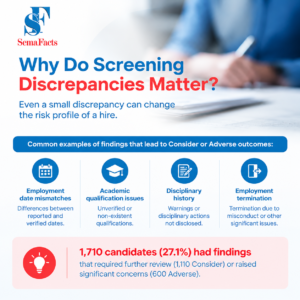
- Semafacts screening insights: 27.1% of 6,310 classified screening outcomes required further review or raised significant concerns.
Common Background Screening Discrepancies
1. Employment Date Mismatches
Employment history verification is an essential component of pre-employment screening.
Candidates may indicate employment dates on their CVs that differ from the records maintained by their previous employers.
For example, a candidate may indicate that they worked for an organization from January 2020 to December 2023, while the employer confirms that their employment ended in June 2023.
Such differences may result from administrative errors, inaccurate recollection or deliberate misrepresentation.
Background screening discrepancies involving employment history can help employers identify inconsistencies that require clarification before making hiring decisions.
Why it matters: Employment dates help employers assess professional experience, employment gaps and whether candidates meet the experience requirements of a position.
Rather than automatically treating inconsistencies as misconduct, employers should seek clarification and evaluate the significance of the discrepancy.
2. Academic Qualification Discrepancies
Academic qualification verification helps establish whether candidates possess the educational credentials they claim.
Some discrepancies may involve:
- Certificates that cannot be authenticated by the issuing institution.
- Qualifications issued by institutions whose accreditation status requires further investigation.
- Differences between the qualification presented and the institution’s official records.
- Certificates or transcripts containing inconsistent information.
Why it matters: Academic qualifications are often fundamental requirements for employment, particularly in technical, professional and regulated occupations.
Employers who fail to verify these credentials may unknowingly recruit individuals who do not meet the educational requirements of their positions.
3. Undisclosed Disciplinary History
Employment verification and reference checks may reveal relevant disciplinary matters that were not disclosed during recruitment.
These may include formal warnings, disciplinary proceedings or other documented workplace concerns.
However, disciplinary findings must be assessed in context.
A warning letter does not automatically mean a candidate is unsuitable for employment. Employers should consider the nature of the incident, its relevance to the prospective role, the available evidence and any explanation provided by the candidate.
Why it matters: Understanding relevant disciplinary history can help employers assess workplace risks, particularly for positions involving financial responsibility, confidential information, safety or leadership.
4. Employment Termination and Reasons for Leaving
Candidates may provide reasons for leaving previous employment that differ from information confirmed by their former employers.
For example, a candidate may indicate that they resigned voluntarily, while employment records show that their contract was terminated.
However, termination does not necessarily indicate misconduct. Employment may end because of restructuring, redundancy, performance concerns, contractual changes or other circumstances.
Why it matters: Verifying the circumstances surrounding previous employment can provide employers with additional context when assessing a candidate’s suitability.
Any findings should be evaluated fairly, with appropriate consideration of the candidate’s explanation.
How Screening Outcomes Are Classified
At Semafacts, screening outcomes help clients interpret verification findings.
Clear — No Discrepancies Identified
The information verified is consistent with the records obtained from the relevant sources.
Consider — Further Review Required
A discrepancy or finding has been identified that may require clarification. Examples include differences in employment dates or relevant disciplinary information requiring further assessment.
Adverse — Significant Findings Identified
The verification has identified a significant concern, such as a qualification confirmed to be fraudulent or a material misrepresentation of employment history.
An Adverse outcome should prompt careful assessment rather than automatic rejection.
Importantly, these classifications communicate screening findings; the ultimate employment decision remains with the hiring organization.
Why Background Screening Discrepancies Matter to Employers
Understanding background screening discrepancies helps organizations identify potential hiring risks while ensuring candidates are assessed fairly and objectively.
Protecting Organizational Integrity
Employees represent an organization’s values, reputation and operational standards.
Verifying their backgrounds helps employers identify material inconsistencies and assess potential risks before making employment decisions.
Making Evidence-Based Hiring Decisions
Background screening provides independently verified information that complements interviews, assessments and reference checks.
This enables employers to evaluate candidates using a more complete understanding of their qualifications and professional histories.
Reducing Recruitment Risks
Hiring individuals without verifying relevant credentials or employment history may expose organizations to operational, financial, regulatory or reputational risks.
A structured screening process helps identify concerns that may otherwise remain undetected.
Promoting Fairness in Recruitment
Background checks should not be viewed solely as a way of identifying negative information.
They also help confirm genuine qualifications and employment histories, protecting candidates whose credentials are accurate.
Where discrepancies arise, candidates should have an appropriate opportunity to clarify or challenge findings before adverse employment decisions are made.
The Importance of Responsible Background Screening in Kenya
Background screening involves processing personal information and must be conducted responsibly.
In Kenya, employers and background screening providers should comply with the Data Protection Act, 2019, including applicable requirements concerning lawful processing, transparency, data minimization, security and the rights of data subjects.
The Office of the Data Protection Commissioner (ODPC) oversees the implementation of Kenya’s data protection framework and provides guidance on responsible processing of personal information.
Organizations should ensure that screening is relevant to the position, that appropriate lawful grounds and authorizations are established, and that sensitive information is handled confidentially.
Verification findings should also be interpreted objectively, with due consideration of accuracy, context and fairness.
How Semafacts Supports Informed Hiring Decisions
At Semafacts Services Limited, we provide comprehensive background screening and verification services to help organizations make informed recruitment decisions.
Our services include:
- Employment history verification
- Academic qualification verification
- Professional membership and licence verification
- Reference checks
- Identity verification
- Criminal record checks
- Credit history checks
- Global sanctions and watchlist screening
Our approach focuses on independently confirming information through relevant sources, identifying discrepancies, and providing clients with clear, structured verification reports.
Our verification specialists assess background screening discrepancies by confirming information directly with relevant institutions, employers and other authorized sources.
We recognize that every finding requires context. Our objective is not simply to flag discrepancies but to provide reliable information that supports fair and informed decision-making.
Conclusion: Verify the Facts Before Making the Decision
Our historical screening records demonstrate why background checks remain an important part of responsible recruitment.
With 27.1% of classified screening outcomes requiring further review or raising significant concerns, employers have good reason to look beyond CVs, interviews and self-declared qualifications.
Not every discrepancy means fraud, and not every adverse finding automatically disqualifies a candidate.
What matters is understanding the facts, evaluating their significance and making decisions based on reliable information.
Understanding background screening discrepancies allows employers to assess findings fairly, minimize recruitment risks and make informed hiring decisions.
At Semafacts, we believe informed hiring decisions begin with accurate verification.
Don’t just assume. Verify.
For professional background screening and verification services in Kenya, contact Semafacts Services Limited.
Website: www.semafacts.com